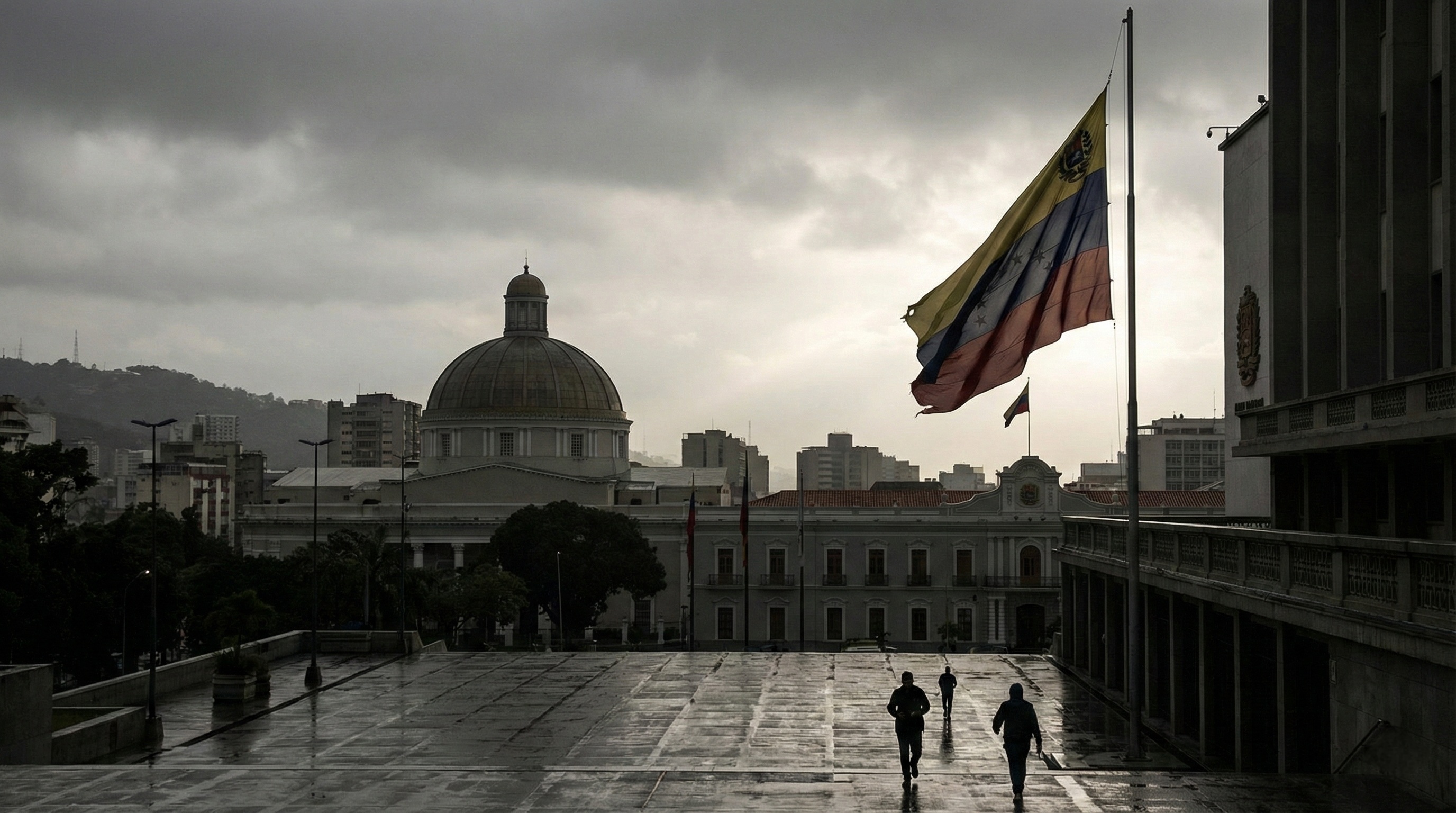

Eighteen months after the pivotal July 2024 election, a grim normalcy has settled over Caracas. Nicolás Maduro remains in Miraflores Palace, inaugurated a year ago for a third term that few outside his inner circle recognize as legitimate. To the casual observer, or perhaps a tourist in the dollarized bubble of Las Mercedes, the regime appears entrenched, immovable, and victorious. The protests have subsided, the opposition leadership is largely in exile, and the oil—however haltingly—continues to flow.
But to confuse survival with control is a dangerous analytical error. As Venezuela enters 2026, we must ask a fundamental question: Does Nicolás Maduro actually govern Venezuela, or is he merely occupying the machinery of the state? The distinction between power and legitimacy has never been starker, and it reveals a regime that is not strong, but brittle—calcified into a position where it can block change but cannot build a future.
The Architecture of Survival
Power, in the rawest Weberian sense, is the ability to enforce one’s will against resistance. By this metric, Maduro possesses it in spades. His retention of the presidency despite the landslide vote against him in 2024 is a testament to a sophisticated, if brutal, survival apparatus.
He has successfully coup-proofed the military through a mix of surveillance and shared spoils. He has neutralized the immediate threat of street mobilization by forcing the opposition candidate, Edmundo González Urrutia, into asylum in Spain and driving the charismatic María Corina Machado into the shadows. The judicial system remains a loyal extension of his executive will, ready to ratify any decree.
If the definition of "control" is simply remaining in the presidential chair, then Maduro is in control. But in modern politics, control implies the capacity to administer territory, implement policy, and command the voluntary obedience of the citizenry. On these fronts, the Bolivarian Revolution has evaporated.
The Legitimacy Vacuum
The crisis of January 2025, when Maduro was sworn in for the 2025-2031 term, marked the final severance of the state from its people. In previous years, Chavismo could claim a shrinking but genuine base of ideological support. Today, that base has eroded to a transactional core.
The government no longer seeks to convince; it seeks only to exhaust. The absence of political legitimacy—the widely held belief that a leader has the right to rule—creates a governance paralysis. Because the population views the administration as a usurper, there is no civic buy-in for state initiatives. Laws are obeyed only out of fear, taxes are evaded, and the social contract is void.
This legitimacy vacuum has consequences beyond the philosophical. It scares away the massive foreign direct investment required to rebuild the country’s crumbling energy infrastructure. China and Russia may offer lifelines, but they are loans, not investments, calculated to extract resources rather than build capacity. A government that cannot borrow on international markets and cannot tax its own citizens is a government that cannot govern; it can only scavenge.
The Fragmentation of the State
Perhaps the most damning evidence of Maduro’s loss of control is the fragmentation of Venezuelan territory. While the regime holds Caracas, vast swathes of the interior are governed by a patchwork of non-state actors. In the mining arc of the south, syndicates and guerrilla groups manage the extraction of gold. In the barrios, criminal gangs often provide the security and social services the state has abandoned.
Maduro has essentially subcontracted sovereignty to keep the peace. He tolerates these fiefdoms because he lacks the resources to police them and the legitimacy to replace them. This is not the hallmark of a totalitarian stongman; it is the characteristic of a failing state manager who has retreated to the capital to defend the throne while the kingdom fractures.
The Great Exit
The ultimate metric of a regime’s failure is the vote of the feet. The migration crisis, which has seen nearly a quarter of the population flee, is not just a humanitarian tragedy; it is a continuous, rolling referendum.
In 2025 and early 2026, the exodus shifted. It is no longer just the desperate poor, but the remaining middle class and skilled professionals who, realizing the political deadlock is indefinite, have chosen to liquidate their lives and leave. A ruler who presides over the emptying of his nation is not in control of its destiny; he is merely the warden of those who remain behind.
The Stalemate of 2026
So, where does this leave us? We are witnessing a "zombie equilibrium." The opposition, despite its moral victory in 2024 and the undeniable support of the street, lacks the coercive power to dislodge the regime. The international community, fatigued by years of crisis and distracted by conflicts in Europe and the Middle East, has largely shifted from "maximum pressure" to containment.
Maduro bets that time is on his side—that the world will eventually accept his rule as a fait accompli. He believes that stability, even the stability of a graveyard, will eventually be rewarded with normalization.
But this is a miscalculation. A regime without legitimacy is inherently unstable. It requires constant, expensive maintenance of the repression apparatus. It is vulnerable to sudden shocks—a drop in oil prices, a health crisis, or a fracture within the security forces—because it has no cushion of public goodwill to fall back on.
Nicolás Maduro is not driving the car; he is merely pressing the brakes. He has stopped the vehicle of Venezuelan democracy from moving forward, but he has no engine to take the country anywhere else. He holds the palace, the guns, and the stamps. But he does not hold Venezuela. He is merely occupying it.